Transforming UX Hiring

Rethinking how we hire designers — from exhausting, outdated gatekeeping to a process that respects candidates and actually works.

Executive Brief

3 rounds max
~1 month faster time to hire
0 unpaid design exercises

Mandate & Constraints

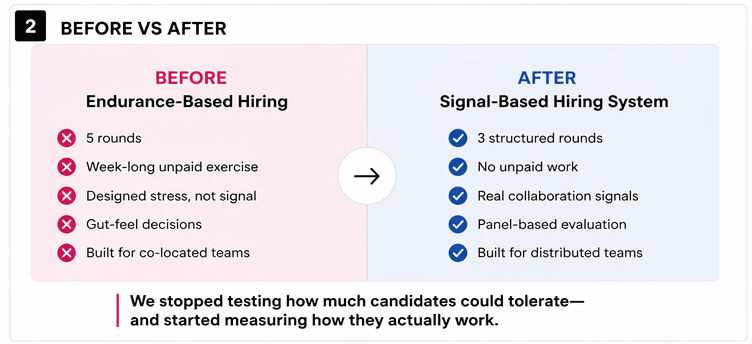
When I joined Paychex in 2021 as their first remote UX Manager, the hiring process was still running on pre-COVID assumptions. Five rounds. An unpaid take-home exercise that realistically took a week. And a deliberate curveball in the design review to see how candidates performed under manufactured pressure. The problem wasn’t that it was hard. It was that it was designed to filter for endurance rather than fit, and it was completely disconnected from how our distributed team actually worked together.

Decision Framework

Respect the candidate's time.
An unpaid week of work is not a portfolio review. It's extraction. No process I run will ask for work we don't intend to compensate.
Signal, not stress.
The goal of an interview is to understand how someone thinks and collaborates. A fake crisis tells you how someone performs under fake pressure. That's not useful data.
Peers are the best judges of fit.
The people who will work alongside a new hire every day have the clearest read on whether that person belongs. Build the process around their input, not around gatekeeping from above.

Plays I Ran

Built a coalition
didn't go to our Director alone. I found a partner in another remote UX Manager who'd seen the same problems firsthand. We brought a concrete proposal, not just a complaint.
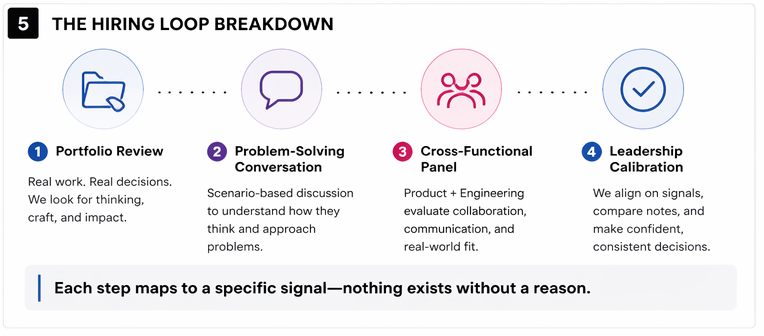
3-round process
Round one is a conversation between the candidate and two managers. Genuine give and take, one hour. Round two is a portfolio panel with the candidate's potential peers from the UX org: 15 to 20 minutes of presentation, then open Q&A in both directions. Round three is a 30-minute conversation with senior leadership, calibrated to the seniority of the role.
Eliminated unpaid exercise,
If you want to see how someone designs, look at what they've already made. That's what a portfolio is for.
Stress-tested with 7 reqs
A few months after launch we had seven simultaneous open headcount from growth and backfill. The new process ran all seven at once. It held up, and that's when it went from experiment to required org policy.
Brought to Logility with cross-disciplinary panel
Leadership had already decided no design exercises but had no replacement. I brought the Paychex model and adapted it: the peer panel became cross-disciplinary, including Product and Engineering, which better reflects how design actually operates.

Outcomes & Signals

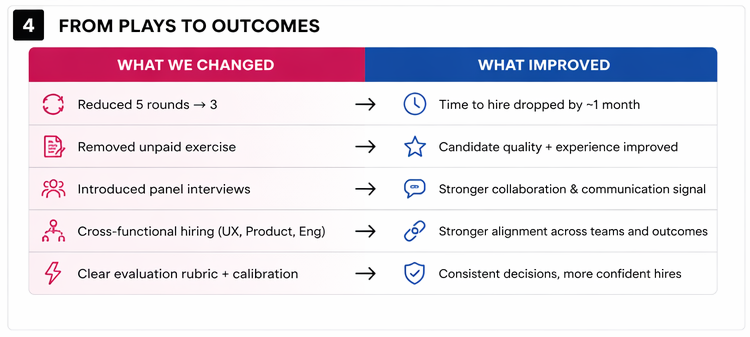
  • Time to hire dropped by nearly a month on average across both organizations
  • Candidate quality improved, with stronger signal on collaboration and communication coming out of the panel format
  • The process scaled to seven simultaneous open reqs at Paychex without breaking
  • Adopted as required policy at Paychex and carried forward as standard practice at Logility
  • Cross-disciplinary panel at Logility strengthened relationships between UX, Product, and Engineering from the interview stage forward

Evidence

I don't have any artifacts at the moment for this case study.

What I'd Do Next

  • A lightweight candidate feedback loop to understand how the process lands from their side
  • Structured calibration sessions after each panel to make evaluation criteria more consistent across hiring managers

See More Work

Browse the case study list or read about how I lead