Logility — Teaching AI to Think Like a UX Lead

Built a complete machine-readable design system specification that encodes UX standards, component rules, and supply chain patterns into AI-readable Skills — freeing the UX team to focus on strategy and new component work while AI handles implementation consistently.

Executive Brief

98 Skills Delivered
100% Component Coverage
0 Designers Required at Generation Time

Mandate & Constraints

Engineering was building with AI — Polaris, an internal Claude Code platform — and doing it without design guardrails. Components were being used incorrectly, validation patterns were inconsistent, and accessibility was inconsistent. Every implementation required a designer in the loop to catch what the AI got wrong.

The opportunity: encode UX expertise directly into the platform so AI generates correct, accessible, on-brand code by default. That frees the UX team from implementation review cycles and puts their time back where it creates the most value — research, strategy, and evolving the design system itself.
Decision Framework

Encode, Don't Document
Traditional documentation gets ignored. Skills are read by the AI at generation time — the standards are applied automatically, not consulted voluntarily.
Components + Patterns
Component-level rules alone don't make a product. Cross-cutting pattern Skills encode the judgment that spans multiple components: how to structure a form, what to show when a table is empty, when to use a spinner vs a skeleton.
Constitution as Capstone
A project Constitution contribution makes the standards non-negotiable at the platform level — not a suggestion, but the rules the AI operates under.

Plays I Ran

Skills Library — Component Level
Built 92 component Skills covering every component in the Assemble Design System v3.0.0 — encoding correct usage, when-not-to-use rules, v3 breaking changes, supply chain-specific examples, and accessibility requirements. Sourced directly from Storybook documentation to ensure accuracy.
Skills Library — Pattern Level
Built 6 cross-cutting pattern Skills encoding judgment that no single component Skill can provide: form validation sequencing, form layout conventions, the canonical supply chain list view, master-detail layout variants, loading state decision trees, and empty state content rules.
Constitution Contribution
Wrote the UX section of the Polaris project Constitution — the authoritative ruleset that governs all AI-generated UI on the platform. Severity color mappings, non-negotiable rules, notification standards, accessibility baselines, and Skills priority order all codified in one place.
Architect Handoff
Packaged the complete library as a portable zip with a human-readable README index, technical notes for integration, and a breaking changes summary — ready for beta testing by the engineering team that stays.

Outcomes & Signals

  • 98 Skills delivered covering 100% of Assemble Design System v3.0.0 components
  • Every breaking change from v2→v3 documented and encoded as an explicit rule
  • Supply chain-specific patterns (order status severity mapping, import wizard flow, warehouse capacity meter) baked into examples throughout
  • Complete form validation pattern eliminates the most common class of AI-generated form bugs: keystroke validation, vague error messages, missing server error handling
  • UX standards persist and scale beyond the team's immediate capacity.

Evidence

README file for the Skill
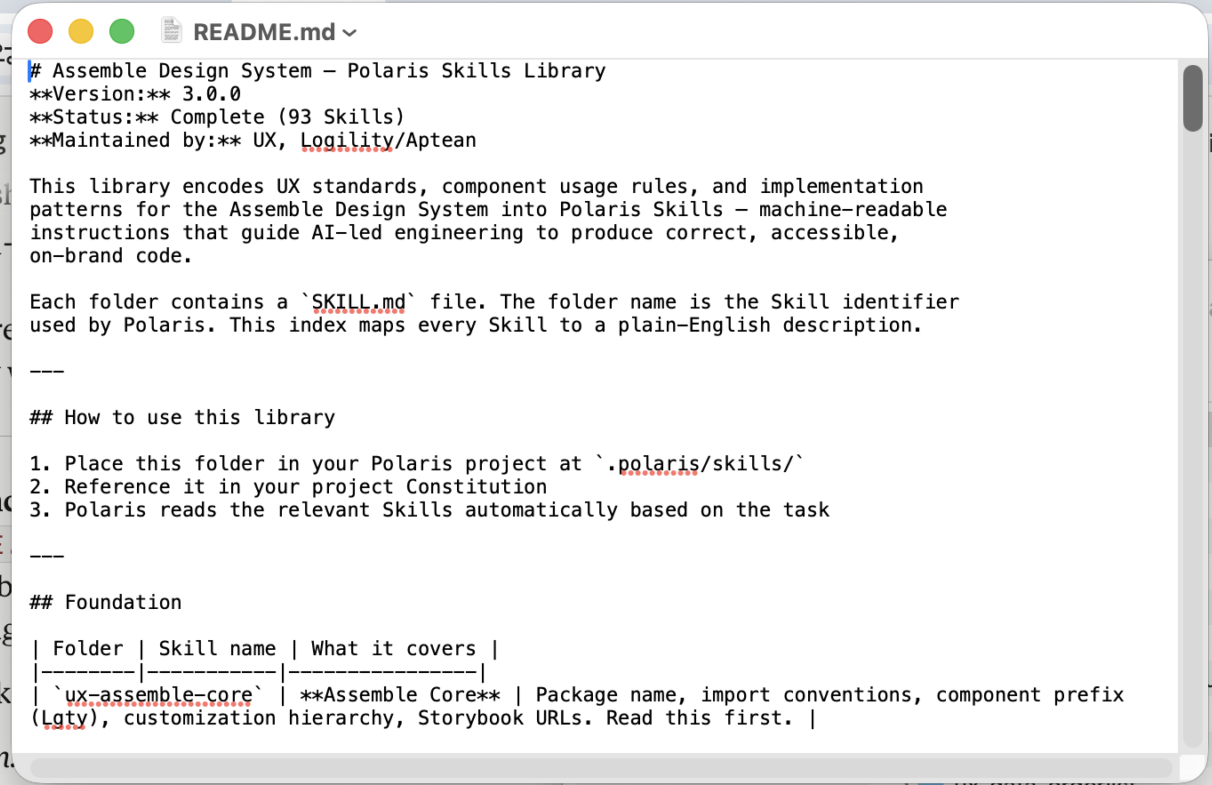
Skills Library Index
Human-readable index mapping all 98 Skills to plain-English names, one-line descriptions, and technical integration notes. Sent to the engineering architect for beta testing on Polaris.
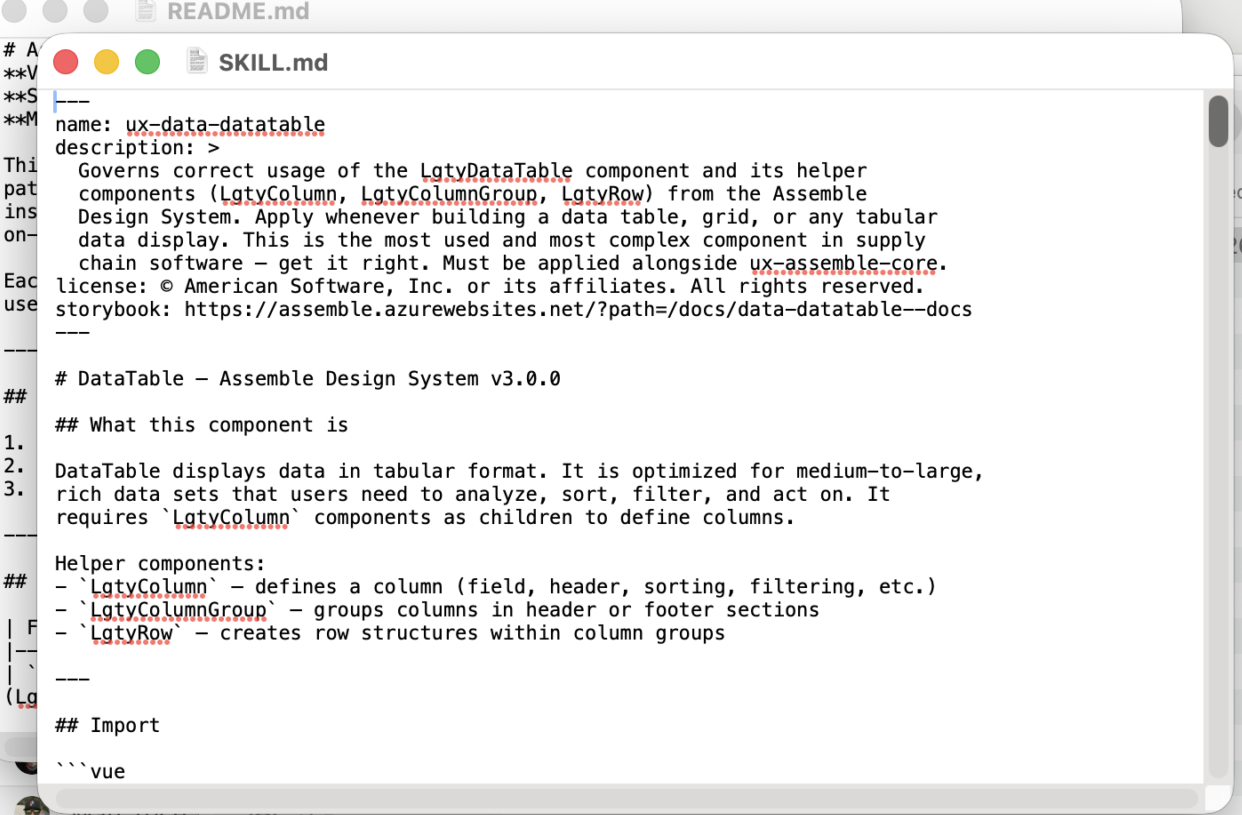
A Component Skill
Component Skill — DataTable
One of 92 component-level Skills encoding correct usage, v3 breaking changes, supply chain-specific examples, and accessibility requirements — sourced directly from Storybook to ensure accuracy.
A Pattern Skill
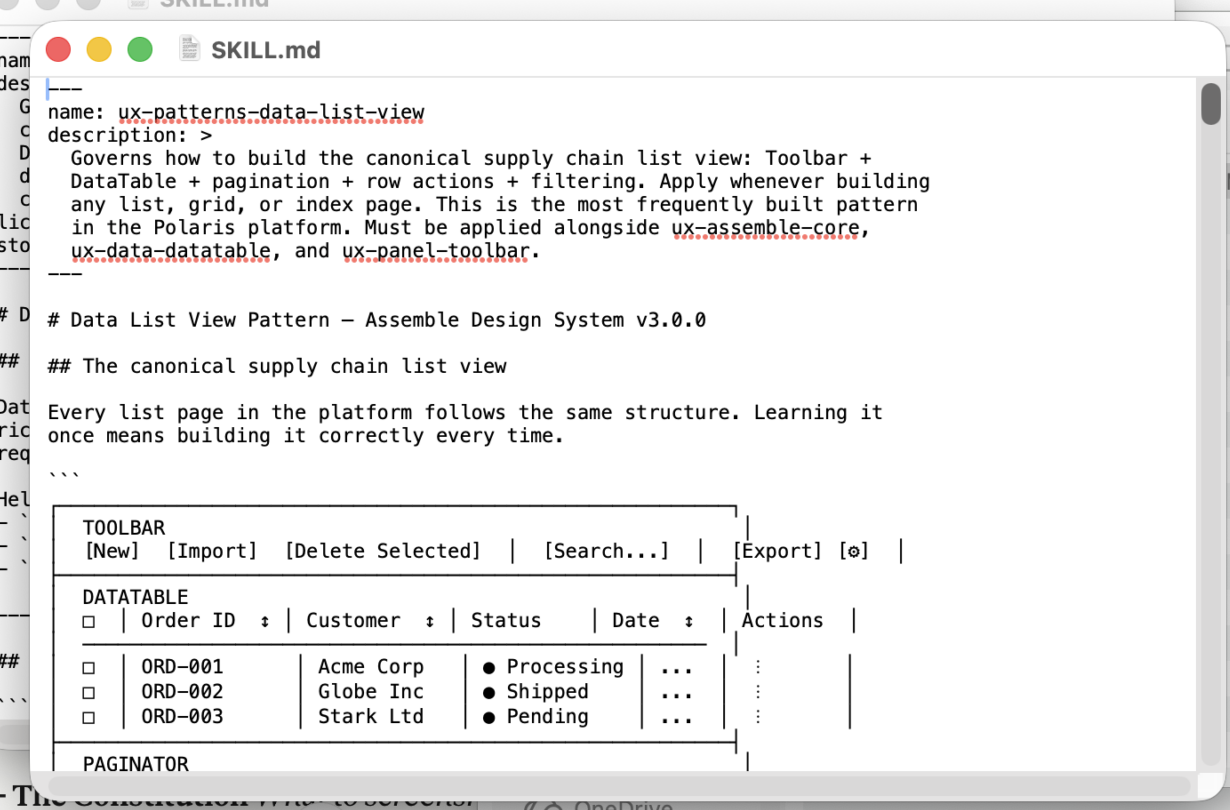
Canonical List View Pattern
Cross-cutting pattern Skill encoding the standard supply chain list page — Toolbar, DataTable, pagination, row actions, and filtering — with rules that span multiple components and can't live in any single component Skill.
The Constitution
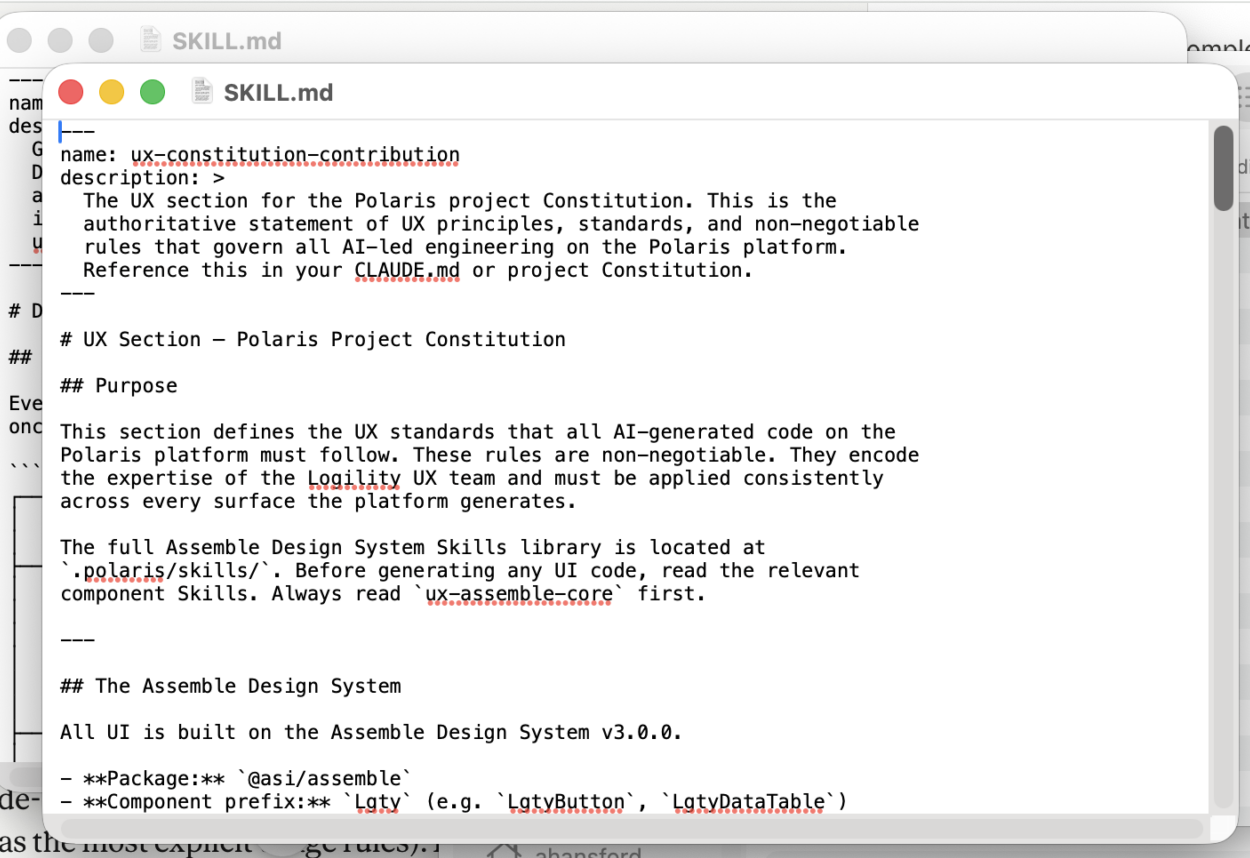
UX Constitution — Standards Codified
The UX section of the Polaris project Constitution, defining non-negotiable rules for all AI-generated UI — including consistent severity color mappings that apply across every surface in the product.
Storybook Source vs Skill Output
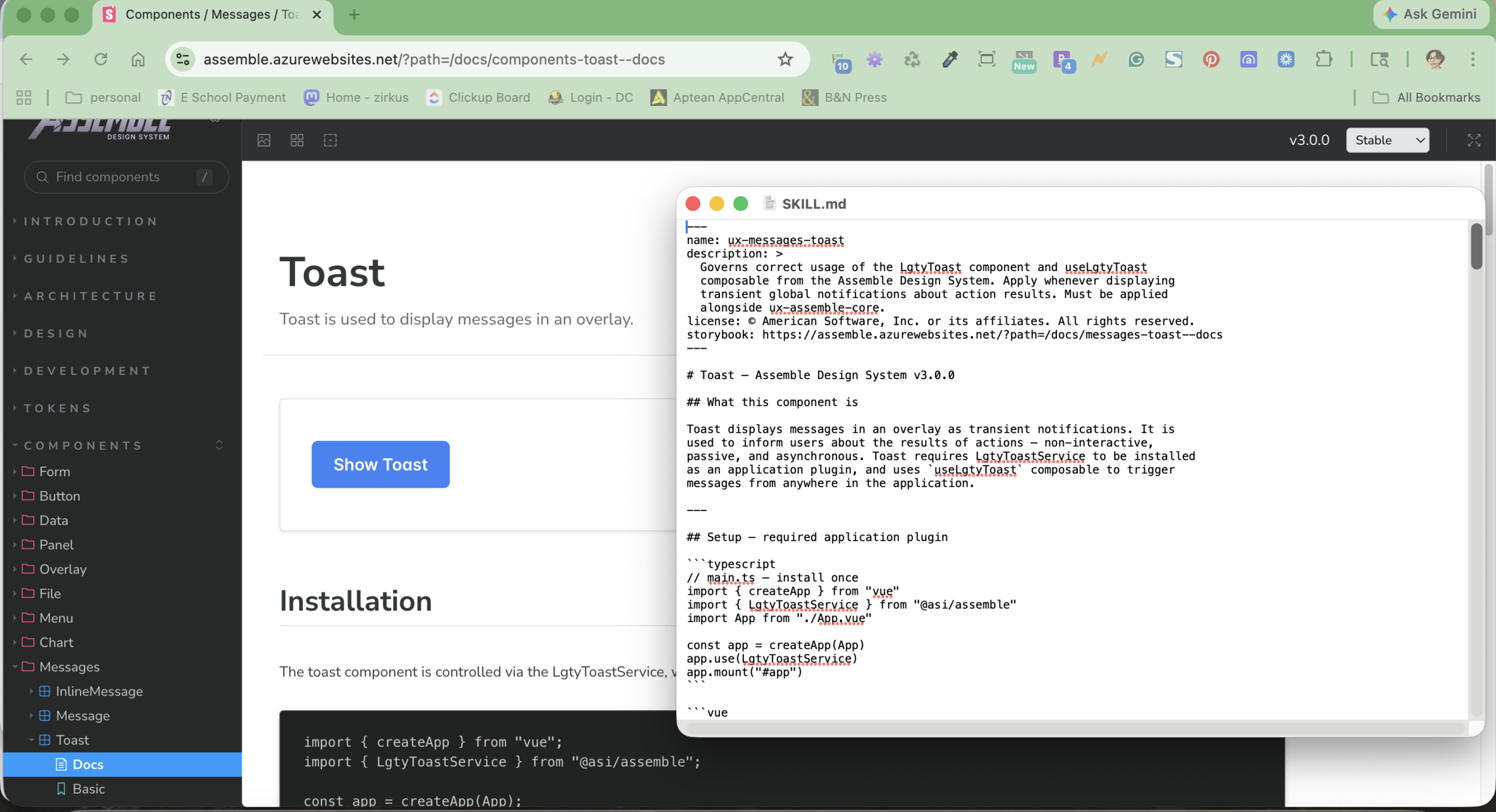
Source to Skill — Design System to AI Instruction
Each Skill was sourced directly from Assemble Design System Storybook documentation, translating component specs and usage guidance into machine-readable instructions that Polaris reads at code generation time.

What I'd Do Next

  • Component adoption analytics to measure which Skills are triggered most frequently — use that signal to prioritize where the UX team focuses new component and pattern work
  • A prompt-testing eval suite to verify Skills produce correct output after Assemble version updates
  • Expand to interaction patterns beyond layout: optimistic UI, error recovery flows, undo patterns

See More Work

Browse the case study list or read about how I lead