
Peter Merholz is living in my head again.
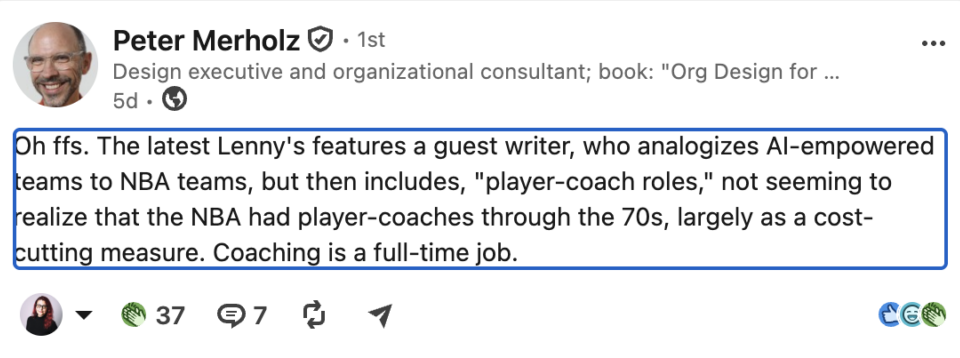
This one hit me somewhere specific. I worked at NBA Digital for years, and while the player-coach era was long before my time there, it’s institutional memory for any super-fan who worked there (oh, and there were lots of them). It’s the kind of thing that gets referenced in rooms where people have been around long enough to know how it ended. It ended because the game got too complex and too fast for one person to do both jobs well. The players who were also coaching weren’t bad at either thing individually. They just couldn’t do both at the same time without something slipping. Usually it was the coaching.
Sound familiar?
The Player-Coach Is Everywhere Now
Spend an afternoon on LinkedIn looking at UX leadership job postings, and you’ll find the player-coach model embedded in almost every one of them. “Hands-on leadership role.” “You’ll contribute directly to design work.” “Player-coach who thrives at the intersection of strategy and execution.” The language varies, but the idea is the same: we want someone who manages the team and also does the work the team does.
I’ve seen this pattern inside Agile methodology too, and it always confused me. The tech lead who also mentors the team. The lead designer who also owns the design system and also runs design reviews and also ships features. The idea that you can hold down a full IC workload and a management function simultaneously and do either one well.
You can’t. Not really. Not the parts that matter.
What Gets Left Behind
Here’s the thing about multitasking: I have what I call the Too-Much Gene. I run multiple projects simultaneously both in professional and personal life, I have always worked this way, and I’m genuinely not bad at it. So I’m not making an argument against multitasking in general.
I’m making an argument about a specific kind of work that cannot be done in the margins.
People management is not a task you can slot between tickets. The parts of management that actually matter are the conversations that don’t have an agenda, the check-ins that turn into something unexpected, the moment when you notice that someone is quieter than usual and you make time to find out why. Those moments don’t schedule themselves. They require presence and continuity and a manager whose attention isn’t already fully accounted for by their own deliverables.
The reason player-coach keeps showing up in job descriptions isn’t because companies have thought carefully about it and decided it works. It’s because people management is hard to quantify. You can count screens shipped. You can count story points closed. You cannot count the conversation that kept a designer from burning out, or the piece of feedback that changed how someone thinks about their own work for the next decade.
This is the same logic that broke public education in the United States. No Child Left Behind reduced teaching to test scores because test scores are measurable and the other ninety percent of what a great teacher does is not. We’re doing the same thing to design leadership right now. We’re measuring the artifact and calling the rest of it overhead.
What Management Actually Produces
A few years ago, one of my designers left for what sounded like a brilliant opportunity. I couldn’t give him that experience at the time, and I told him so. He left and we stayed in touch. Over the months that followed I could hear in our conversations and texts that the role was nothing like what he’d been shown in the interview. When a position opened up on my team, we had a direct conversation about what coming back would look like. It was a fully lateral move. Same title, same approximate compensation. There was no obvious upside on paper.
He came back anyway. He told me it was knowing I’d be his manager again that made it work.
That is not something you can put in a spreadsheet. It doesn’t show up in a velocity chart or a design system adoption rate. It took years to build and it is exactly the kind of thing that disappears when the person responsible for building it is also responsible for shipping thirty percent of the team’s output every sprint.
The Real Cost of the Player-Coach
The player-coach model doesn’t fail because the person in the role isn’t talented enough. It fails because you’ve taken the job of building and sustaining a team and treated it as something that can be done in the gaps. The management becomes incidental. The IC work is the actual job and the people stuff is what you do for HR compliance.
And the team knows. They always know. You can feel the difference between a manager who has time for you and a manager who is managing you between Figma sessions. One of them builds the kind of trust that makes someone take a lateral move to work with you again. The other one ships features.
In a world where AI can generate the screens, the argument for keeping humans in the loop is not that humans are better at making pixels. It’s that humans are better at building the conditions where other humans do their best work. That is a management argument, not a craft argument. And it only works if the people doing the managing actually have time to manage.
Coaching is a full-time job. Peter Merholz is right. The NBA figured this out fifty years ago. We’re still catching up.
Amber Hansford is a Director of UX based in Atlanta. She spent years working on NBA Digital and has been watching the player-coach problem show up in every other industry ever since. She writes about design leadership, DesignOps, and the structural decisions that determine whether design has actual influence or just the appearance of it. This post was inspired by Peter Merholz, who keeps writing things that are already living in her head.