
AI Didn’t Put Design in a Box. We Did. But Here’s How We Can Get Out.
Peter Merholz published a piece this week that is worth reading if you care about the future of UX. His diagnosis is sharp: design spent the last decade narrowing itself into a production function, mistook delivery velocity for strategic influence, and is now watching AI fill the box it built for itself. The coffin metaphor is earned, and I agree with most of what he wrote.
Where I want to add to the conversation is the prescription to this hole that we’ve dug for ourselves. Moving left, being more strategic, recapturing the mid-2000s positioning — these are the right destinations. But for the vast majority of designers and design leaders who have only ever operated within the narrow model he describes, knowing where to go is not the same as knowing how to get there. The terrain between here and there is where most people get stuck.
So let me try to fill in some of that terrain.
The Floor Went Up. The Ceiling Came Down.
Merholz notes that the floor of digital design quality has risen over the past twenty years while the ceiling has lowered. Fewer outright bad experiences, but also fewer transcendent ones. I think this is a perfect description of what we’ve lived through, and I think the reason is simpler than it looks.
When you optimize for speed to ship, you optimize for the layer of design that is fastest to produce. That layer is the surface. Pixels, screens, components, UI. It is the most visible layer, the most legible to non-designers, and the most easily replicated by AI tools. It is also the least consequential layer if the four layers underneath it have not been thought through.
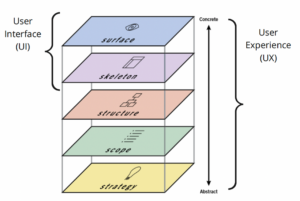
Jesse James Garrett mapped this in 2000 and nobody has improved on it since. UX is five planes, built in sequence: Strategy, Scope, Structure, Skeleton, Surface. Each layer depends on the one below it. A beautiful interface built on an unexamined strategy is not good design. It is expensive wallpaper.
What AI tools like Claude Design, Google Stitch, and Canva produce is surface. Fast, consistent, increasingly competent surface. And if that is what your organization believes design is, then yes, those tools are a direct replacement for your design team. Because your design team was only ever doing surface work anyway.
That is not an AI problem. That is a scope problem that predates AI by at least a decade.
What A Balanced Team Actually Protects
Marty Cagan has written extensively about what a truly empowered product team looks like. Not a feature factory executing against a roadmap handed down from above, but a balanced team of product, design, and engineering working together to discover and deliver solutions to real customer problems. The emphasis is on discovery as much as delivery. The emphasis is on the whole problem, not just the sprint.
In a balanced team model, design is not downstream of product. Design is not handed a spec and asked to make it look good. Design is in the room when the problem is being defined, when the hypothesis is being formed, and when the strategy is being set. Design brings the customer’s voice into decisions before those decisions get expensive to reverse.
When that model works, here is what it actually looks like in practice: designers are present throughout the entire software development lifecycle, not just at the moment someone needs screens. They are in discovery sessions. They are in roadmap conversations. They are in the room when the team is deciding what to build and why, not just how it should look.
That presence is what protects the full JJG stack. Not a title. Not a seat at the executive table in the abstract. Actual, consistent presence in the conversations where strategy, scope, and structure get decided. Because if design is not in those conversations, someone else is making those decisions without design input, and by the time a designer sees the work, it is already too late to address anything above the skeleton layer.
The Feature Factory Is A Design Failure
When a product team uses Agile purely as a delivery mechanism, treating the sprint as the unit of work rather than the customer problem as the unit of work, you get a feature factory. Things ship. The backlog shrinks. Velocity numbers look good in the quarterly review. And the product drifts further and further from what customers actually need because nobody is asking that question at the beginning of the process. They are asking it, if at all, at the end, when the research comes back, and the sprint has already started.
This is not an Agile failure. Agile was never meant to be a developer methodology. It was meant to be a whole-team practice. The balanced team model that Cagan describes is Agile done correctly, with design embedded in the discovery work that precedes delivery rather than bolted on as a production function at the end.
AI accelerates the feature factory. It does not fix it. If your organization was already skipping strategy, scope, and structure to get to the surface faster, AI tools will help you skip those layers even faster and ship even more things that do not solve the right problem. Speed is not the issue. Direction is.
What Actually Needs To Happen
Merholz is right that designers need to move left. But moving left is not a mindset shift. It is a structural one, and it requires design leaders to fight for it explicitly rather than accepting whatever position the organization offers them.
Here is what that looks like in practice.
Design needs to be in the room at the beginning of every significant initiative, not invited in after the requirements are written. This means design leaders advocating for their teams’ presence in product strategy conversations, roadmap planning sessions, and discovery work as a non-negotiable, not a nice-to-have.
Research needs to be connected to decisions, not filed away in a repository. The organizations that have retained design’s strategic relevance are the ones where user research directly informs what gets built, not just how it gets built. That connection does not happen automatically. It requires design leaders who know how to translate research findings into product decisions and who have the relationships with product and engineering leadership to make that translation stick.
Design systems need to free designers from production work, not replace designers entirely. A well-governed design system should mean that the surface layer largely takes care of itself, which frees the design team to work on the harder problems upstream. Instead, many organizations used design systems to justify reducing headcount. That is a false economy that will show up in the product within eighteen months.
And design leaders need to stop measuring their success by the number of screens their teams produce. If that is what you are tracking, that is what you are optimizing for, and that is what you will get.
The Part We Have To Own
Merholz asks whether we can trust the people who enabled this to get us out of it. It is a fair question and an uncomfortable one.
The discipline did narrow itself. Too many design leaders accepted the production model because it was legible to the business, because it was easier to defend in a budget conversation than the strategic work that is harder to quantify, and because keeping the engineers happy felt like progress. The fetishization of craft that Merholz and Ovetta Sampson both name is real. Portfolios full of beautiful screens with no evidence of the thinking that preceded them. Job descriptions that prioritize Figma proficiency over strategic judgment. A generation of practitioners who were never shown that design could be anything other than the last step before engineering.
That is on us. Acknowledging it is not self-flagellation; it’s a prerequisite for changing it.
The question is not whether AI can replace the surface layer of design work. It clearly can, increasingly well, and organizations are going to use it to do exactly that. The question is whether design as a discipline is going to make itself irreplaceable by doing the work that AI cannot do: understanding what customers actually need, translating that understanding into strategic direction, and being present throughout the entire process to make sure that direction holds.
That work exists above the surface. It always has.
The organizations that figure that out, and the design leaders who fight for it, are the ones who will matter in five years. The ones who keep optimizing for faster screens are building a very efficient road to nowhere.
Amber Hansford is a Director of UX based in Atlanta with 15 years of experience building design organizations that work above the surface. She writes about design leadership, DesignOps, and the structural decisions that determine whether design has actual influence or just the appearance of it. Peter Merholz’s piece referenced above is worth your time: petermerholz.com